


Baking by weight is one of the simplest ways to improve your baking. Learn why measuring ingredients in grams creates more consistent breads, cookies, cakes, and pastries, while taking the guesswork out of every recipe.
July 2, 2026
Baking by Weight: Why a Kitchen Scale Changes Everything

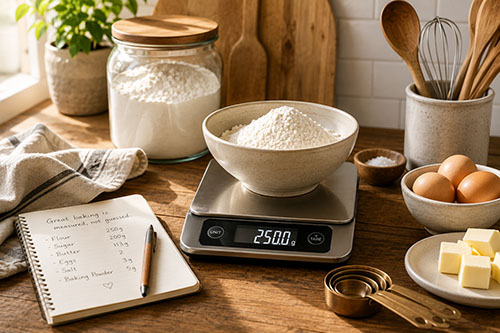
One of the simplest upgrades you can make in your kitchen costs less than a few bags of flour.
A kitchen scale.
It may not be as exciting as a new mixer or a beautiful baking dish, but if you bake regularly, it can completely change your results.
If you’ve ever wondered why one loaf of bread turns out beautifully while the next feels dense, or why a batch of cookies spreads more than expected, the answer may come down to how the ingredients were measured.
For many home bakers, a kitchen scale is the single tool that improves consistency the fastest. And once you start using one, it’s difficult to imagine baking without it.
Why Baking by Weight Changed My Kitchen
For years, I baked the same way as many home bakers do, using measuring cups and spoons. Some recipes turned out beautifully, while others were a complete flop.When I switched to baking by weight, everything became more consistent.
The change wasn’t dramatic overnight, but over time I noticed fewer disappointments, more reliable results, and a greater understanding of how ingredients work together. Instead of wondering why a recipe worked one week but not the next, I could focus on learning the technique itself. What surprised me most wasn’t the accuracy. It was the confidence it built.
Bread dough became easier to understand. Recipes became easier to repeat. I wasted fewer ingredients and spent less time troubleshooting problems that were often caused by inconsistent measurements.
Looking back, a kitchen scale was one of the simplest changes I’ve made in my kitchen, but it had one of the biggest impacts.
Today, every baking recipe I develop for My Weathered Table is tested and written using weight measurements because I believe it gives home bakers the best opportunity for success.
A Kitchen Scale Can Save You Money
One of the benefits people rarely mention when discussing kitchen scales is how much money they can save over time.
Every loaf of bread, batch of muffins, tray of cookies, or homemade dessert requires ingredients you’ve purchased with your grocery budget. When recipes fail because ingredients were measured inconsistently, those ingredients are often wasted.
A loaf that doesn’t rise, cookies that spread too much, muffins that turn out dry, or a cake that never quite comes together all have something in common. They represent ingredients, time, and money.
While occasional baking mistakes happen to everyone, accurate measurements can help reduce many of the common issues that lead to disappointing results.
A kitchen scale helps create consistency from the start. And consistency means fewer failed recipes, less wasted food, and better use of the ingredients already in your pantry.
At My Weathered Table, we believe confidence in the kitchen starts with consistent success and a simple kitchen scale is one of the easiest ways to do exactly that.
The Problem with Measuring Cups
Most of us learned to bake using measuring cups.
There is nothing wrong with that. In fact, many treasured family recipes have been passed down using cups and spoons for generations.
The challenge is that measuring cups are not always consistent.
Take flour as an example. One person may scoop directly into the flour bag, another may spoon the flour into the measuring cup, while someone else may shake the cup to level it. Each method produces a slightly different amount of flour.
The difference may seem small, but in baking, small differences matter.
Too much flour can create dry cookies, dense doughs, or heavy bread. Too little flour can affect structure, texture, and rise. Even a small variation can change the outcome of a recipe.
When recipes are measured by weight, those variables largely disappear.
The scale doesn’t care how you scoop.
One hundred grams is always one hundred grams.
That consistency is the foundation of reliable baking.
The Benefits of Baking by Weight
Once you begin baking by weight, the benefits become apparent very quickly.
More Consistent Results
When you measure by weight, your recipes become easier to repeat. Your favorite loaf of bread tastes the same next month as it did this week. Your muffins rise the way you expect, and your cookies bake more predictably.
Consistency removes much of the frustration that can come from baking. Instead of wondering what went wrong, you gain confidence knowing your measurements are working in your favor.
Less Cleanup
Many recipes can be mixed directly in one bowl.
Place the bowl on the scale, press the tare button, and add each ingredient one at a time. There is no need to wash multiple measuring cups and spoons along the way.
Fewer dishes may seem like a small benefit, but it quickly becomes one of the reasons many bakers never go back.
Easier Recipe Scaling
Whether you’re doubling a recipe for a family gathering, cutting one in half, or making extra dough for the freezer, weights make adjustments simple.
Instead of converting fractions and juggling measuring cups, you can easily multiply or divide ingredient weights while maintaining accuracy.
Choosing a Kitchen Scale
The good news is that you do not need an expensive scale.
Many affordable digital scales work beautifully for everyday home baking. In fact, some of the simplest models are more than capable of handling everything from cookies and muffins to artisan bread dough.
When choosing a scale, look for a few basic features:
- Gram measurements
- A tare function
- An easy-to-read display
- A flat surface for bowls
- A capacity of at least 5 kilograms
Simple is often best.
The goal is not to buy another gadget. The goal is to make baking easier, more predictable, and more enjoyable.
The Kitchen Scales I Use
If you’re ready to start baking by weight, a simple digital kitchen scale is one of the best investments you can make.
I’ve linked the scales I personally use and recommend below.
[Amazon Affiliate Links]
Why My Weathered Table Uses Grams for Baking Recipes
If you’ve spent time browsing recipes on My Weathered Table, you may notice that baking recipes are written using grams rather than cups.
That choice is intentional.
One of the goals of My Weathered Table is to help home cooks and bakers build confidence through understanding ingredients and techniques. When it comes to baking, weight is one of the simplest ways to create consistent results.
A cup of flour can vary depending on how it is measured.
One hundred grams of flour is always one hundred grams.
By sharing baking recipes in grams, I can provide the same measurements I use in my own kitchen and help readers achieve more reliable results at home.
I understand that baking by weight may feel unfamiliar at first. It certainly felt different to me when I made the switch. But after a few recipes, it quickly becomes second nature.
More importantly, it removes much of the guesswork from baking. Less guesswork often means fewer failed recipes, less wasted food, and greater confidence in the kitchen.
That philosophy aligns perfectly with Pantry Foundations.
The goal is not perfection.
The goal is helping you create dependable results with ingredients you’ve worked hard to bring into your kitchen.
The My Weathered Table Philosophy
A kitchen scale is not about perfection. It is not about making baking feel more technical, and it is certainly not about turning your kitchen into a laboratory.
It is about confidence.
Confidence when you’re baking sandwich bread for the week, mixing pizza dough for family dinner, making muffins on a Saturday morning, or baking cookies to share with friends.
The goal is not perfect baking.
The goal is dependable baking.
Because when you trust your measurements, you spend less time wondering what went wrong and more time enjoying the process.
You waste fewer ingredients. You make better use of your grocery budget. And you gain confidence with every loaf, muffin, cookie, and cake.
That is what Pantry Foundations is all about.
Frequently Asked Questions
Do I Need a Kitchen Scale to Bake?
No. People have baked successfully with measuring cups for generations. A scale simply provides greater consistency and accuracy.
Should I Measure in Grams or Ounces?
Grams are generally preferred because they offer greater precision and are commonly used in professional baking. They also make it easier to scale recipes up or down without complicated conversions.
Is a Kitchen Scale Worth the Investment?
Absolutely. A kitchen scale is one of the most affordable tools you can add to your kitchen, yet it can have a significant impact on your baking results. More consistency, less waste, and greater confidence make it well worth the cost.
Will Baking by Weight Make Baking More Complicated?
Not at all. Most bakers find the opposite is true. Once you become familiar with using a kitchen scale, measuring ingredients often becomes faster and simpler than using multiple measuring cups and spoons. Many recipes can even be mixed in a single bowl, which means less cleanup as well.
Is Baking by Weight Only for Bread Bakers?
No. While bread bakers often notice the benefits first, baking by weight improves consistency for all types of baking. Cookies, muffins, cakes, brownies, pie dough, biscuits, and pastries can all benefit from more accurate measurements.
One of the simplest upgrades you can make in your kitchen costs less than a few bags of flour.
A kitchen scale.
It may not be as exciting as a new mixer or a beautiful baking dish, but if you bake regularly, a scale can completely change your results.
If you’ve ever wondered why one loaf of bread turns out beautifully while the next feels dense, or why a batch of cookies spreads more than expected, the answer may come down to how the ingredients were measured.
For many home bakers, a kitchen scale is the single tool that improves consistency the fastest. And once you start using one, it’s difficult to imagine baking without it.
For years, I baked the same way many home bakers do, using measuring cups and spoons. Some recipes turned out beautifully, while others were less predictable.
A loaf of bread might be perfect one week and slightly dense the next. A batch of muffins could vary from one bake to another, even when I followed the same recipe.
When I switched to baking by weight, everything became more consistent.
The change wasn’t dramatic overnight, but over time I noticed fewer disappointments, more reliable results, and a greater understanding of how ingredients work together.
Today, every baking recipe I develop for My Weathered Table is tested and written using weight measurements because I believe it gives home bakers the best opportunity for success.
Why Baking by Weight Changed My Kitchen
When I switched to baking by weight, I wasn’t trying to become a professional baker.
I simply wanted more consistent results.
What surprised me most wasn’t the accuracy.
It was the confidence.
Bread dough became easier to understand. Recipes became easier to repeat. I wasted fewer ingredients and spent less time wondering why a recipe worked one week but not the next.
Looking back, a kitchen scale was one of the simplest changes I’ve ever made in my kitchen, but it had one of the biggest impacts.
That experience is one of the reasons this article exists.
A Kitchen Scale Can Save You Money
One of the benefits people rarely mention when discussing kitchen scales is how much money they can save over time.
Every loaf of bread, batch of muffins, tray of cookies, or homemade dessert requires ingredients you’ve purchased with your grocery budget. When recipes fail because ingredients were measured inconsistently, those ingredients are often wasted.
A loaf that doesn’t rise.
Cookies that spread too much.
Muffins that turn out dry.
A cake that never quite comes together.
While occasional baking mistakes happen to everyone, accurate measurements can help reduce many of the common issues that lead to disappointing results.
A kitchen scale helps create consistency from the start. And consistency means fewer failed recipes, less wasted food, and better use of the ingredients already in your pantry.
At My Weathered Table, we believe confidence in the kitchen starts with respecting the ingredients we bring home.
A simple kitchen scale is one of the easiest ways to do exactly that.
The Problem with Measuring Cups
Most of us learned to bake using measuring cups.
There is nothing wrong with that.
In fact, many treasured family recipes have been passed down using cups and spoons for generations.
The challenge is that measuring cups are not always consistent.
Take flour as an example. One person may scoop directly into the flour bag, another may spoon it into the measuring cup, while someone else may shake the cup to level it.
Each method produces a slightly different amount of flour.
The difference may seem small, but in baking, small differences matter.
Too much flour can create dry cookies, dense muffins, or heavy bread. Too little flour can affect structure, texture, and rise.
When recipes are measured by weight, those variables largely disappear.
The scale doesn’t care how you scoop.
One hundred grams is always one hundred grams.
Baking Is Part Science
Cooking often allows room for improvisation.
A little more garlic in a soup rarely causes problems. An extra handful of herbs may even improve the dish.
Baking works differently.
Flour, liquids, fats, sugar, eggs, and leavening agents all work together in specific ratios. Changing one ingredient affects the final result.
That doesn’t mean baking is difficult.
It simply means consistency matters.
When ingredients are measured accurately, recipes become easier to repeat successfully. Instead of wondering whether a recipe will work, you can focus on enjoying the process.
Why Professional Bakers Use Scales
Walk into almost any professional bakery and you’ll find scales everywhere.
Professional bakers rely on weight because it removes guesswork and creates consistency. One hundred grams of flour today is exactly the same as one hundred grams of flour tomorrow.
The measurement never changes.
That reliability allows bakers to reproduce the same recipe again and again with confidence.
Home bakers deserve that same confidence.
Using a scale brings a little bit of that bakery consistency into your own kitchen.
The Benefits of Baking by Weight
Once you begin baking by weight, the benefits become apparent very quickly.
While accuracy is often the first thing people notice, it is far from the only advantage.
More Consistent Results
Perhaps the biggest benefit is consistency.
When you measure by weight, your recipes become easier to repeat. Your favorite loaf of bread tastes the same next month as it did this week. Your muffins rise the way you expect, and your cookies bake more predictably.
Consistency removes much of the frustration that can come from baking.
Instead of wondering what went wrong, you gain confidence knowing your measurements are working in your favor.
Less Cleanup
Many recipes can be mixed directly in one bowl.
Place the bowl on the scale, press the tare button, and add each ingredient one at a time. There is no need to wash multiple measuring cups and spoons along the way.
Fewer dishes may seem like a small benefit, but it quickly becomes one of the reasons many bakers never go back.
Easier Recipe Scaling
Need to double a recipe for a family gathering?
Cut a recipe in half?
Make extra dough for the freezer?
Weights make adjustments simple. Instead of converting fractions and juggling measuring cups, you can multiply or divide ingredient weights with ease.
Better Bread Baking
Bread is often where bakers notice the biggest difference.
Bread dough responds directly to hydration levels. Even small changes in the ratio of flour to water can affect how a dough mixes, rises, and bakes.
A scale helps create consistency from loaf to loaf and makes it easier to understand how dough behaves over time.
Choosing a Kitchen Scale
The good news is that you do not need an expensive scale.
Many affordable digital scales work beautifully for everyday home baking.
When choosing a scale, look for a few basic features:
- Gram measurements
- A tare function
- An easy-to-read display
- A flat surface for bowls
- A capacity of at least 5 kilograms
Simple is often best.
The goal is not to buy another gadget. The goal is to make baking easier, more predictable, and more enjoyable.
Why My Weathered Table Uses Grams for Baking Recipes
If you’ve spent time browsing recipes on My Weathered Table, you may notice that baking recipes are written using grams rather than cups.
That choice is intentional.
At My Weathered Table, one of our goals is to help home cooks and bakers build confidence through understanding ingredients and techniques. When it comes to baking, weight is one of the simplest ways to create consistent results.
A cup of flour can vary depending on how it is measured.
One hundred grams of flour is always one hundred grams.
By sharing baking recipes in grams, I can provide the same measurements I use in my own kitchen and help readers achieve more reliable results at home.
I understand that baking by weight may feel unfamiliar at first. It certainly felt different to me when I made the switch.
But after a few recipes, it quickly becomes second nature.
More importantly, it removes much of the guesswork from baking. Less guesswork often means fewer failed recipes, less wasted food, and greater confidence in the kitchen.
That philosophy aligns perfectly with Pantry Foundations.
The goal is not perfection.
The goal is helping you create dependable results with ingredients you’ve worked hard to bring into your kitchen.
The Kitchen Scales I Use
If you’re ready to start baking by weight, a simple digital kitchen scale is one of the best investments you can make.
I’ve linked the scales I personally use and recommend below.
[Amazon Affiliate Links]
Common Questions About Baking by Weight
Many home bakers worry that using a scale will feel complicated.
The opposite is usually true.
After a few recipes, most people find it faster than measuring cups. Instead of reaching for multiple tools, you simply place a bowl on the scale and add ingredients until you reach the desired weight.
Once the habit forms, it quickly becomes second nature.
Do I Need a Kitchen Scale to Bake?
No.
People have baked successfully with measuring cups for generations. A scale simply provides greater consistency and accuracy.
Should I Measure in Grams or Ounces?
Grams are generally preferred because they offer greater precision and are commonly used in professional baking.
Are Kitchen Scales Expensive?
Not necessarily.
Many reliable digital kitchen scales are affordable and work well for everyday home baking.
What Is the Tare Function?
The tare function resets the scale to zero after placing a bowl on it. This allows you to add multiple ingredients to the same bowl without additional calculations.
Is a Kitchen Scale Useful for Bread Baking?
Absolutely.
Bread dough is highly dependent on accurate flour and water measurements, making a scale one of the most valuable tools a bread baker can own.
H2: The My Weathered Table Philosophy
A kitchen scale is not about perfection.
It is not about making baking feel more technical. And it is certainly not about turning your kitchen into a laboratory.
It is about confidence.
- when you’re baking sandwich bread for the week.
- when you’re mixing pizza dough for family dinner.
- when you’re making muffins on a Saturday morning.
- when you’re baking cookies to share with friends.
Confidence when you’re making muffins on a Saturday morning.
Confidence when you’re baking cookies to share with friends.
The goal is not perfect baking.
The goal is dependable baking.
Because when you trust your measurements, you spend less time wondering what went wrong and more time enjoying the process.
You waste fewer ingredients. You make better use of your grocery budget. And you gain confidence with every loaf, muffin, cookie, and cake.
That is what Pantry Foundations is all about.


