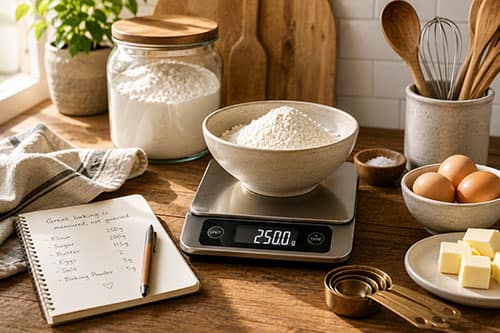
Baking by Weight: Why a Kitchen Scale Changes Everything
July 2, 2026
Discover why a digital kitchen scale can improve consistency, simplify measuring, reduce cleanup, and build confidence in everyday cooking and baking.
A kitchen scale may be one of the smallest pieces of equipment in your kitchen, but it can completely change the way you cook and bake.
It removes guesswork. It improves consistency. It makes recipes easier to scale, portions easier to divide, and sticky measuring cups almost unnecessary.
Most importantly, weighing ingredients helps you understand what is happening inside a recipe. Instead of hoping today’s cup of flour matches yesterday’s, you begin with a dependable amount every time.
That kind of consistency builds confidence. Once you experience it, the kitchen scale stops feeling like an extra step and starts feeling like one of the simplest ways to make cooking and baking easier.
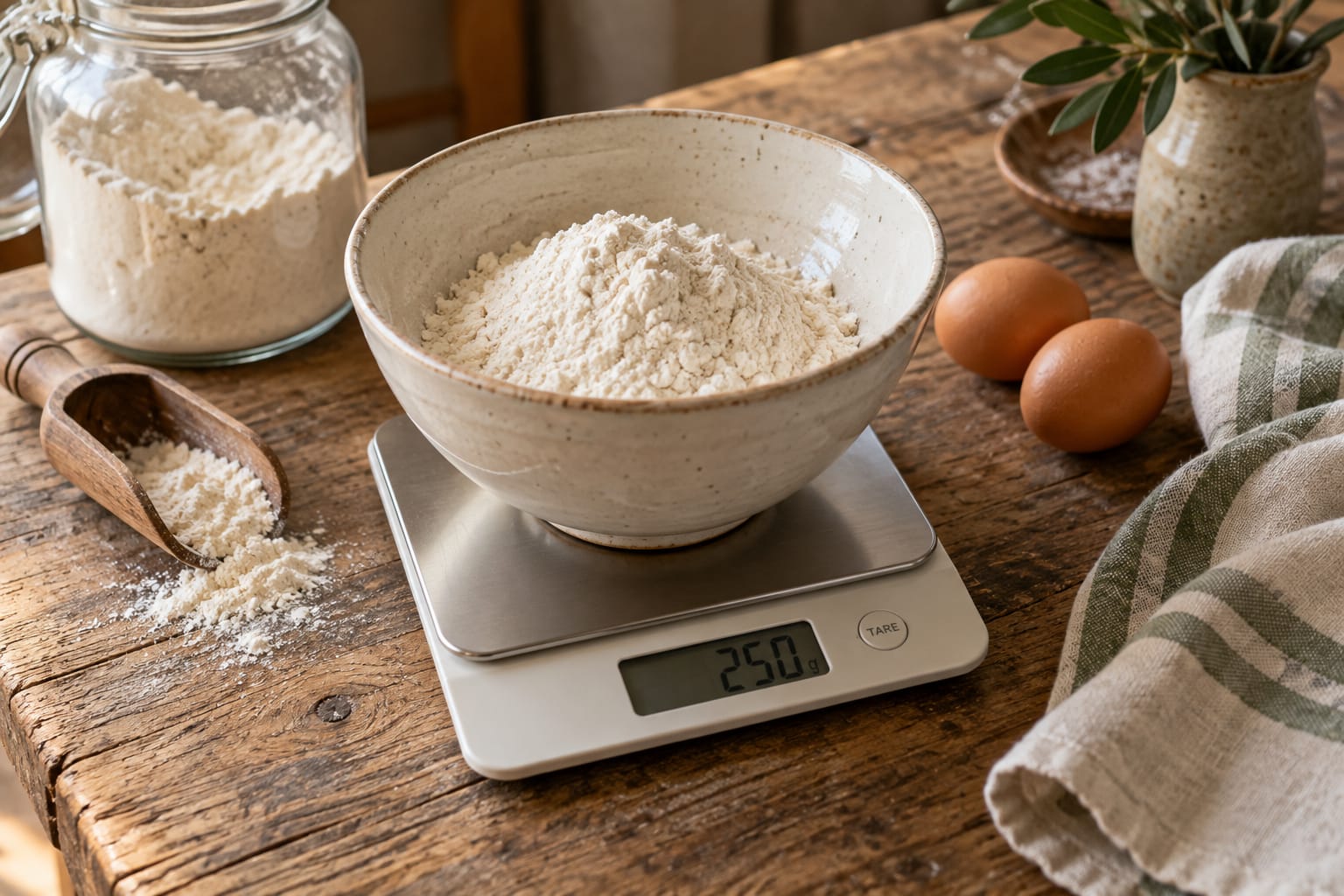
Why Weight Is More Reliable Than Volume
Measuring cups tell us how much space an ingredient occupies. A kitchen scale tells us how much that ingredient weighs.
The difference matters because ingredients settle, compress, and fill measuring cups differently.
Flour offers the clearest example. A cup filled by scooping directly from the bag can hold considerably more flour than a cup filled by gently spooning and leveling. Both look like one cup, but they may not contain the same amount.
Brown sugar can be lightly packed or firmly packed. Chopped nuts can be coarse or fine. Salt crystals vary in size. Honey clings to the measuring cup. Butter may sit above or below the measurement line depending on temperature and shape.
A scale removes those variables.
If a recipe calls for 225 grams of flour, you can measure 225 grams of flour. The method used to fill the bowl no longer changes the amount.

Why Weighing Changes Your Baking
Baking depends on relationships between ingredients.
Flour provides structure. Sugar sweetens while affecting moisture, spread, and browning. Fat contributes tenderness and flavor. Eggs provide moisture, structure, and richness. Leavening ingredients help a batter or dough rise.
When one measurement shifts, the balance of the recipe can shift with it.
Too much flour may create dry cake, dense bread, crumbly cookies, or stiff muffin batter. Too little flour may cause cookies to spread too far or a loaf to lack structure.
Weighing does not guarantee that every recipe will be perfect. Oven temperature, ingredient temperature, mixing, fermentation, and baking time still matter. A scale simply removes one of the biggest variables before the recipe reaches the oven.
That gives you a more dependable place to begin.
Consistency Makes Recipes Easier to Understand
When ingredients remain consistent, troubleshooting becomes easier.
If you bake the same bread twice using the same ingredient weights, you can look more closely at proofing time, dough temperature, shaping, or oven temperature when the results differ.
If your cookie dough weighs the same from batch to batch, you can focus on butter temperature, chilling time, and baking time. That consistency helps when making recipes such as my brown butter chocolate chunk cookies.
Without consistent measurements, it becomes difficult to know whether the recipe changed because of technique or because one cup of flour contained more than another.
Precision does not remove creativity. It creates a reliable foundation for it.
Once you understand how a recipe behaves, you can make thoughtful adjustments and recognize what each change contributes.
What to Look for in a Kitchen Scale
You do not need an expensive professional scale for everyday cooking and baking.
Look for a digital kitchen scale with a few dependable features:
- Gram measurements: Grams make it easy to measure ingredients without working with fractions.
- A tare function: This resets the display to zero after you place a bowl on the scale or add an ingredient.
- One-gram increments: This level of precision works well for flour, sugar, butter, oats, liquids, and most everyday ingredients.
- A practical capacity: Choose a scale that can hold your mixing bowl and the ingredients inside it.
- A readable display: Make sure a large bowl will not completely cover the numbers.
- A stable platform: The scale should sit flat and remain steady while you add ingredients.
- Easy cleaning: A smooth surface makes flour, sugar, and spills easier to wipe away.
Some bakers also keep a small precision scale for yeast, salt, spices, and other ingredients measured in very small amounts. It can be helpful, but most home cooks can begin with one reliable digital scale and continue using measuring spoons for tiny quantities.

How to Use the Tare Function
The tare button is what makes weighing directly into one bowl possible.
Place your empty mixing bowl on the scale. Press tare to return the display to zero. Add the first ingredient until you reach the amount listed in the recipe.
Press tare again. Add the next ingredient.
Continue resetting the scale between ingredients.
For example:
- Place the bowl on the scale and press tare.
- Add 225 grams of flour.
- Press tare.
- Add 100 grams of sugar.
- Press tare.
- Add the next ingredient.
The scale subtracts the weight of the bowl and each previous ingredient. You only see the amount currently being added.
This method saves time and reduces the number of measuring cups and bowls that need to be washed.
Slow Down Before You Tare
The tare button is wonderfully convenient, but it requires attention.
Once you reset the scale after adding an ingredient, the previous number disappears. If you forget how much you added, you may not be able to separate that ingredient from everything already in the bowl.
Read the recipe before beginning. Keep each ingredient nearby, and pause before pressing tare. A little mise en place makes this easier.
I also recommend adding ingredients slowly as you approach the final amount. Removing a spoonful of flour from the top of a bowl is easy. Removing salt, baking soda, or milk after it has disappeared into the other ingredients is much harder.
For ingredients that could affect the entire recipe if overmeasured, use a separate small bowl. Weigh the ingredient first, then add it to the main mixture.

Which Ingredients Should Be Weighed?
Almost every major ingredient can be measured by weight.
Flour and Other Dry Ingredients
Flour, sugar, oats, cocoa powder, nuts, dried fruit, chocolate, and grated cheese are easy to weigh directly into a bowl. The oats and nuts in my apple cinnamon oatmeal bake are a simple place to practice.
Weighing flour makes an especially noticeable difference because its volume changes depending on how much it has settled or compressed.
Butter and Other Fats
Butter, shortening, nut butter, coconut oil, and other fats can be weighed without pressing them into a measuring cup.
Place the bowl on the scale, tare it, and add the fat until you reach the correct weight.
Liquids
Water, milk, oil, honey, maple syrup, and other liquids can also be weighed.
This is especially useful for sticky ingredients. Instead of coating a measuring cup with honey or peanut butter, you can add the ingredient directly to the bowl.
Remember that milliliters measure volume and grams measure weight. Water is conveniently close to one gram per milliliter, but other liquids may weigh differently because they have different densities. Follow the unit provided by the recipe.
Eggs
Egg sizes can vary.
When accuracy matters, especially during recipe testing or when scaling a recipe, crack the eggs into a small bowl, whisk them, and weigh the amount you need.
This also makes it possible to divide an egg when cutting a recipe in half.
In the MWT kitchen, weighing eggs helps me keep recipe tests consistent and provides a clearer measurement for anyone recreating the recipe.

When Measuring Spoons Still Make Sense
A kitchen scale does not need to replace every measuring spoon.
Many standard kitchen scales measure in one-gram increments and may not respond reliably to very small amounts. Measuring spoons can remain the practical choice for vanilla, baking powder, baking soda, yeast, salt, and spices when a recipe provides teaspoon measurements.
For greater precision, use a small scale designed to measure fractions of a gram.
The goal is not to reject every familiar kitchen method. It is to choose the method that gives the most dependable result for the amount being measured.
Weighing Helps Beyond Baking
A kitchen scale can bring the same consistency to everyday cooking.
Use it to:
- Divide burger or meatball mixtures evenly
- Portion fresh pasta dough
- Divide bread dough into rolls
- Create even pizza dough balls
- Portion cookie dough or muffin batter
- Divide cake batter between pans
- Measure grains, beans, pasta, or oats
- Track how much produce you need for preserving
- Scale dressings, sauces, and spice blends
- Repeat a recipe after an especially successful test
Even portions cook and bake more evenly. Cake layers finish at the same time. Bread rolls brown together. Meatballs share a similar size. Cookies spread at a similar rate.
The result looks more consistent, but it also cooks more consistently.
Scaling Recipes Becomes Simpler
Weights make it easier to increase or decrease a recipe.
If a recipe makes twelve muffins and you want eighteen, multiplying gram measurements is usually easier than multiplying fractions of cups and tablespoons.
Weights also help when dividing dough or batter. For my butterscotch pecan biscotti, dividing the dough evenly helps the two logs bake at a similar rate.
Weigh the finished dough, subtract the weight of the bowl if needed, and divide the total by the number of portions you want.
If a dough weighs 900 grams and you want twelve rolls, each roll should weigh approximately 75 grams.
The portions do not need to be perfectly identical, but the scale gives you a helpful target.
A Simple Weighing Routine
Start with one familiar recipe. An apple cinnamon oatmeal bake gives you another way to practice weighing your ingredients.
Read the recipe completely. Gather the ingredients. Set the scale on a flat surface and switch the unit to grams.
Place the bowl on the scale and press tare. Add each major ingredient by weight, resetting the scale between additions.
Continue using measuring spoons for very small quantities unless your scale can measure them reliably.
Over time, the process becomes natural. You begin reaching for the scale without thinking about it. The numbers make sense, the cleanup becomes lighter, and recipes feel easier to repeat.
Frequently Asked Questions
Do I need a kitchen scale if I already use measuring cups correctly?
Measuring cups can work, especially when you use a careful method. A scale simply offers greater consistency because it measures the actual weight rather than the space an ingredient fills.
Should I measure in grams or ounces?
Grams are usually easier for cooking and baking because they avoid small fractions. Many digital scales offer both grams and ounces, so you can follow the unit provided by the recipe.
Can I weigh everything in one bowl?
Yes, as long as you tare the scale between ingredients and add each one carefully. Weigh ingredients such as salt or leavening separately when an accidental overpour would be difficult to correct.
Why does one cup of flour have different gram weights in different recipes?
Recipe developers may use different measuring methods or flour standards. Follow the gram amount supplied by the specific recipe rather than automatically substituting a universal conversion.
Do I need a precision scale?
Most home cooks do not need one to begin. A standard scale that measures in one-gram increments works for most ingredients. A precision scale becomes helpful when weighing very small amounts of yeast, salt, or strong flavorings.
The Ingredient Philosophy
At My Weathered Table, we believe that understanding ingredients and techniques creates freedom in the kitchen.
A scale is not about making food feel rigid or overly technical. It helps us pay closer attention. It gives us a dependable starting point and allows us to understand how flour, water, butter, sugar, eggs, and salt work together.
When we measure thoughtfully, we waste fewer ingredients on avoidable mistakes. We can repeat the recipes we love, adjust them with purpose, and share them with clearer instructions.
The goal is not perfection.
The goal is confidence.
One bowl, one ingredient, and one dependable measurement at a time. Explore Pantry Foundations for more habits that make everyday cooking and baking easier.

Around My Table
For many years, I baked with measuring cups because that was the way I had learned. The recipes felt familiar, but the results were not always consistent.
Once I began weighing ingredients, something shifted.
Baking became easier to understand. Bread dough became more predictable. Cookies were easier to repeat. Dividing batter and dough became simpler, and recipe testing gave me information I could trust.
The scale did not take the heart out of baking. It gave me more confidence to follow my instincts because I knew I had started with a strong foundation.
If weighing feels unfamiliar, begin with flour in one favorite recipe. Let the scale sit beside the mixing bowl and give yourself time to build the habit.
Small changes often create the greatest confidence in the kitchen, and this one truly is a game changer.
With flour-dusted hands, something simmering nearby, and plenty of laughter and good food to share around the table,


Questions about a recipe or technique?
I’m always happy to help. Feel free to reach out if you need guidance, substitutions, or a little extra help in the kitchen.
Pull up a Chair...
return to pantry foundations
return to recipe box
[email protected]
Questions about a recipe or technique?
I’m always happy to help. Feel free to reach out if you need guidance, substitutions, or a little extra help in the kitchen.
Lisa Marie